
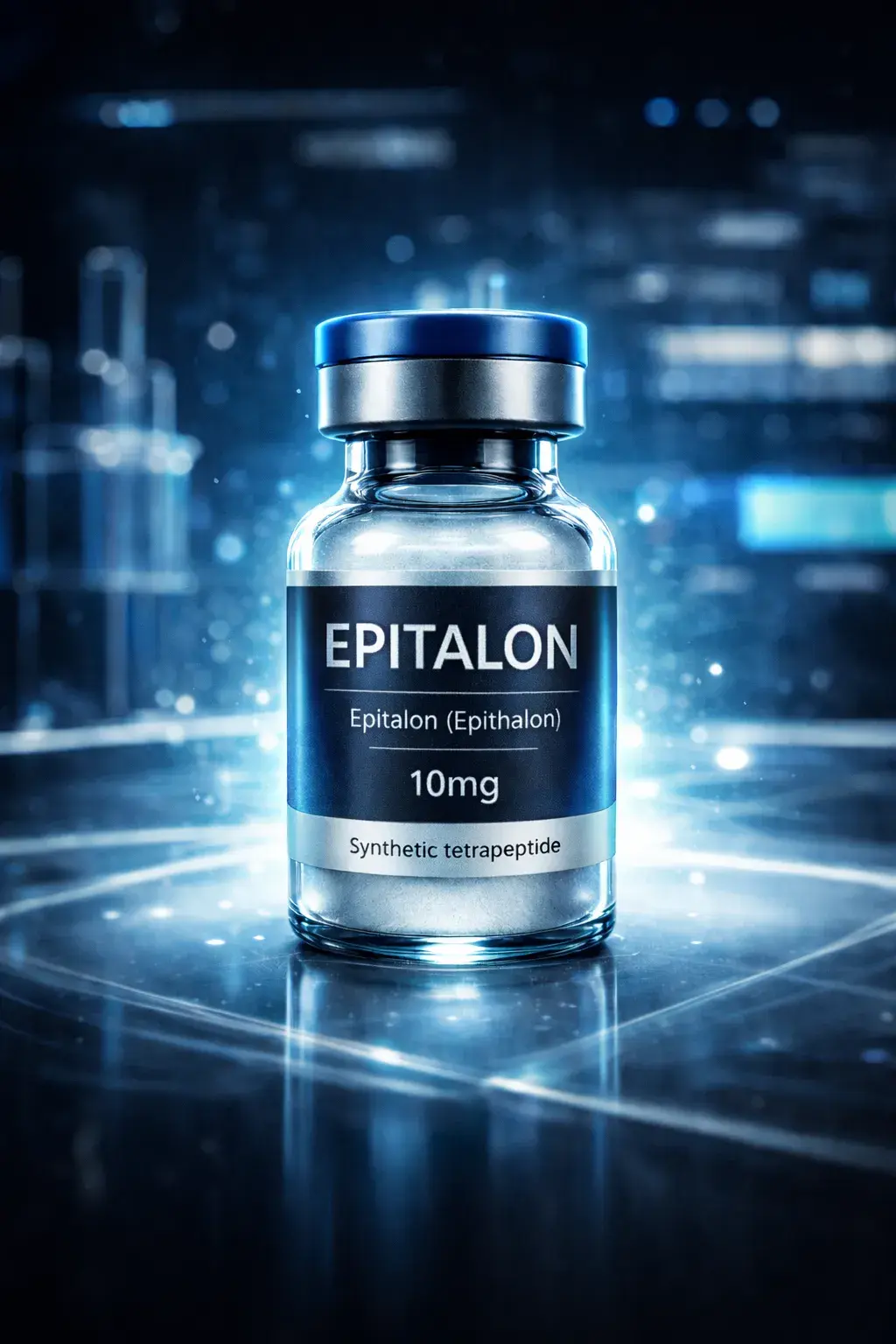
Epitalon (Epithalon)
Epitalon (epithalon) is a synthetic tetrapeptide studied for its effects on telomerase activity and telomere length regulation. Research focuses on its potential role in cellular senescence and aging pathways.
≥98%
10mg
Lyophilized Powder
Store at -20°C. Protect from light and moisture.
Mechanism of Action
Epitalon (AEDG peptide, Ala-Glu-Asp-Gly) is a synthetic tetrapeptide analog of epithalamin, the naturally secreted peptide extract from the pineal gland. It activates telomerase (hTERT) in human somatic cells, catalyzing the addition of TTAGGG telomeric repeats to chromosome ends. This counteracts the progressive telomere shortening that occurs with each cell division and is associated with replicative senescence. Epitalon also stimulates melatonin production in the pineal gland and modulates neuroendocrine function.
Research Overview
Epitalon research originated from the pioneering work of Professor Vladimir Khavinson at the Saint Petersburg Institute of Bioregulation and Gerontology in Russia. Khavinson's team demonstrated that the tetrapeptide AEDG could induce telomerase expression in human somatic cells, a finding published in the Bulletin of Experimental Biology and Medicine in 2003.
Subsequent studies confirmed that Epitalon treatment significantly increased telomere length in human cell lines, with a 2025 PMC-published study demonstrating measurable telomere elongation in fibroblast and endothelial cell cultures. The peptide also showed effects on melatonin synthesis in the pineal gland during aging, potentially linking it to circadian rhythm regulation.
Epitalon's gene expression effects extend beyond telomerase, with studies showing it stimulates gene expression and protein synthesis in aging tissues, including effects on antioxidant enzymes and DNA repair pathways. Research interest has grown substantially, with the peptide being characterized as a potential bioregulatory peptide with pleiotropic anti-aging effects.
Published Research
First demonstration that the AEDG tetrapeptide induces telomerase activity and telomere elongation in human somatic cells.
Confirmed that Epitalon increases telomere length through induction of telomerase reverse transcriptase in multiple human cell lines.
Epitalon prolonged animal lifespan while increasing telomere length, stimulating melatonin synthesis in the pineal gland during aging.
Chemical Profile
| Sequence | Ala-Glu-Asp-Gly (AEDG tetrapeptide) |
| Molecular Formula | C₁₄H₂₂N₄O₉ |
| Molecular Weight | 390.35 g/mol |
| CAS Number | 307297-39-8 |
| Half-Life | Short systemic half-life; rapid renal clearance typical of small peptides |
| Solubility | Freely soluble in water and physiological saline |
| Bioavailability | Subcutaneous administration preferred; small size allows tissue distribution |
Research Applications
References & Further Reading
- Epithalon — Wikipedia— Wikipedia
- Epitalon Telomerase — PubMed Search— PubMed
- Khavinson Peptide Bioregulation — PubMed— PubMed
Research Use Only
This product is intended solely for laboratory research, analytical testing, and educational purposes. NOT FOR HUMAN CONSUMPTION. NOT FOR MEDICAL, VETERINARY, OR DIAGNOSTIC USE. This product has not been evaluated by the FDA.
Related Compounds
GHK-Cu
GHK-Cu (Copper Peptide)
Copper tripeptide complex for tissue remodeling research, 50mg lyophilized.
GLOW
GLOW Peptide Blend
Premium proprietary peptide blend for advanced dermatological research.

KPV
KPV Tripeptide
Alpha-MSH-derived tripeptide for inflammatory pathway research.